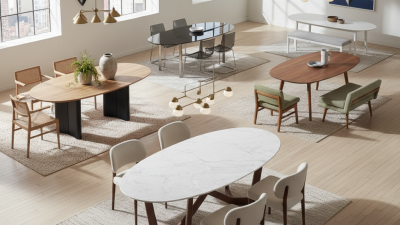
Top China Oval Table Manufacturers for Global Buyers?
Choosing the right Oval Table manufacturer in China requires more than comparing online prices. Global buyers need dependable construction, clear communication, and consistent quality across repeated orders.
Experienced sourcing teams usually inspect wood moisture, edge finishing, weld quality, tabletop stability, and packaging protection. A polished photograph proves little. A sample that survives assembly and transport tells more. Some factories offer solid oak, engineered wood, sintered stone, marble, and metal frames. Each material creates different risks, costs, and maintenance needs.
Details matter.
Eero Saarinen, the influential architect and furniture designer, once explained his table design philosophy: “The undercarriage of tables and chairs in a typical interior makes an ugly, confusing, unrestful world.” His words remain useful when evaluating an Oval Table. A strong design should support conversation, movement, and visual balance without sacrificing durability.
This guide examines leading Chinese manufacturers through practical buyer concerns. These include factory experience, customization capacity, production control, export packaging, sample approval, and after-sales responsiveness. It also considers whether a supplier can reproduce dimensions, colors, and finishes accurately at scale.
The “best” manufacturer is not always the cheapest. That assumption can become expensive. A low quotation may hide thinner materials, weaker hardware, or inadequate corner protection. Even experienced buyers sometimes overlook these details.
There is no perfect supplier for every project. A hotel group may prioritize delivery capacity, while a residential retailer may value flexible designs and smaller minimum orders. Reliable decisions come from comparing evidence, not promises. The manufacturers discussed here deserve attention because their capabilities can be assessed against real purchasing requirements.
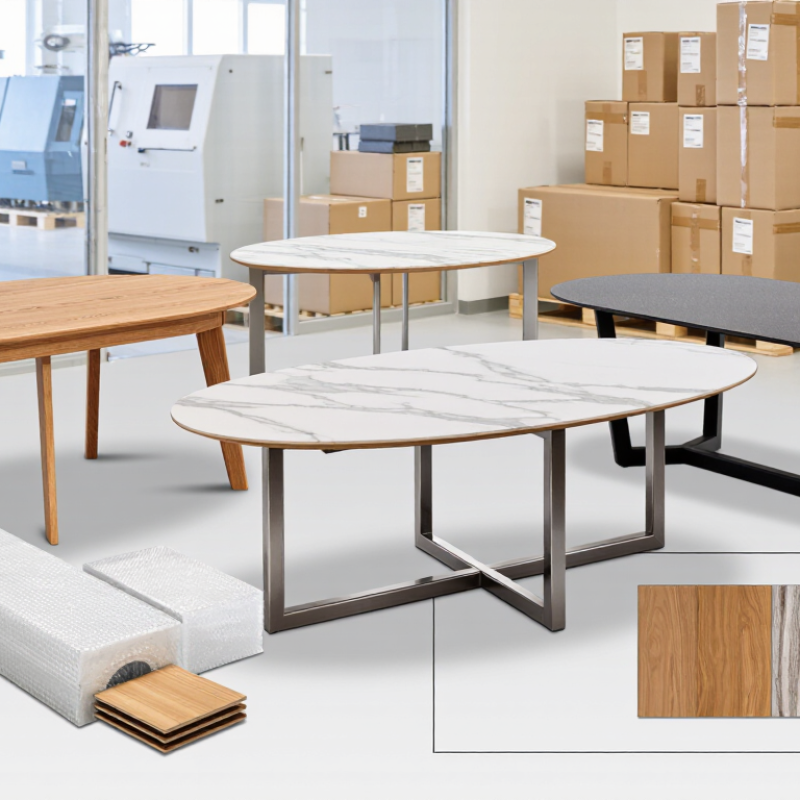
What Defines a Reliable China Oval Table Manufacturer
A reliable China oval table manufacturer proves consistency before discussing price. Statista Market Insights projects global furniture revenue above US$700 billion in 2025, creating intense pressure on suppliers. That pressure can produce shortcuts. Buyers should inspect timber moisture readings, edge finishing, weld penetration, and tabletop flatness. A dependable factory provides dated inspection records, not only polished showroom photographs.
Oval tables also expose weak quality control. Their curved edges require accurate templates and steady sanding. Ask for samples tested under EN 12521 requirements for domestic table strength, stability, and durability. For export orders, packaging deserves equal attention. Corner protectors, foam density, carton drop results, and pallet loading plans should be visible. The International Safe Transit Association reports that packaging tests help identify transport damage risks before shipment. Small details matter.
Look for traceable production batches, clear tolerance limits, and a written correction process. A practical manufacturer should explain what happens when a tabletop arrives warped by three millimeters. No factory is perfect. I would treat an effortless promise as a warning sign. Factory audits, material certificates, and random pre-shipment inspections offer stronger evidence than long experience claims. Clear communication matters, too. Delayed answers often become delayed containers. Reliable partners share realistic lead times, admit defects, and document corrective action. That is less glamorous, but far more useful for global buyers.
Key Types of Oval Tables Made in China
Oval tables from China come in several practical categories, each suited to a different buying brief. Solid wood oval dining tables offer visible grain, warm color, and strong perceived value. Oak, rubberwood, and acacia are common choices. Moisture content matters greatly. Poorly dried timber may warp after shipping.
Engineered wood tables provide more consistent sizing and usually reduce material costs. Veneer surfaces can imitate natural wood while keeping the structure stable. Stone-top oval tables use sintered stone, marble, or quartz surfaces. They create a heavier, premium appearance, but require stronger packaging and reinforced frames. Glass oval tables make smaller dining rooms feel more open. Tempered glass is essential, especially for contract projects.
The base design also changes the table’s function. Pedestal tables improve legroom around crowded dining settings. Four-leg models are easier to repair and often feel more familiar. Folding oval tables support training rooms, events, and flexible office layouts. Extendable designs can grow from a compact family table to a larger gathering surface. Check the extension mechanism carefully. It should open smoothly without uneven gaps.
In factory sourcing, buyers should inspect edge finishing, welds, tabletop thickness, and carton protection. Requesting a physical sample can reveal details that photographs hide. I would not rely on a low quoted price alone. A beautiful top with a weak base becomes an expensive lesson. Specifications may also need revision after testing, which is normal for serious projects.
Key Types of Oval Tables Made in China
Chinese furniture manufacturers commonly produce oval dining, conference, banquet, folding, and coffee tables in a wide range of standard sizes. The chart shows representative typical length ranges in centimeters, not company or market-share data.
Typical product dimensions vary by supplier, customization requirements, seating capacity, and intended application.
How Global Buyers Should Evaluate Manufacturers
Global buyers should evaluate an oval table manufacturer beyond polished photographs. In production audits, I inspect timber moisture, veneer matching, edge sealing, and frame alignment. A sample should survive repeated assembly, not merely look attractive in a showroom. Ask for dimensional tolerances, load-test records, and clear material specifications. Small details matter. Oval tops can expose uneven curves quickly. Request a full-size pre-production sample before approving bulk work.
Reliable factories explain their process without hiding behind sales language. Review machining capacity, finishing rooms, packaging tests, and corrective-action records. A useful visit includes random carton checks and measurements from unfinished stock. If travel is impossible, require timestamped videos, independent inspections, and traceable sample labels. I also compare promised lead times with previous shipment records. Delays happen. Vague explanations are more concerning. Confirm whether the manufacturer controls key processes or quietly outsources them.
Professional evaluation includes commercial discipline. Check product liability coverage, export documentation, payment terms, warranty scope, and replacement procedures. Ask for references from buyers ordering similar quantities and markets. Their feedback should cover color consistency, damage rates, and after-sales response. Do not rely on one perfect sample. Early samples may receive unusual attention. A better test is a small pilot order with agreed inspection points. I have learned that a low quotation can conceal thinner material, weaker hardware, or costly rework. Leave every requirement in writing, including acceptable defects and packaging photographs.
| Evaluation Dimension | Buyer Requirement or Benchmark | Objective Evidence to Request | Positive Signal | Potential Risk |
|---|---|---|---|---|
| Factory Legitimacy | The legal entity, factory address, export capability, and manufacturing scope should be consistent. | Business registration details, factory address, production photographs, export documentation, and a live video or on-site audit. | Information matches across documents and factory records. | Only a trading address is provided or factory access is refused. |
| Quality Management | A documented quality management system should control incoming materials, production, inspection, and corrective actions. | A valid ISO 9001 certificate, inspection procedures, quality records, calibration records, and corrective-action reports. | Certificate scope covers furniture manufacturing and can be verified with the issuing body. | Certificate is expired, unverifiable, or unrelated to the production site. |
| Oval Table Engineering | The design should control tabletop flatness, edge safety, leg stability, load performance, and tolerance consistency. | Technical drawings, material specifications, tolerance limits, assembly instructions, and prototype inspection reports. | The supplier provides measurable tolerances and a documented sample-approval process. | The quotation contains only photographs and no engineering specifications. |
| Material Traceability | Wood, wood panels, metal, glass, coatings, adhesives, and hardware should be identified by grade or specification. | Bills of materials, supplier declarations, material test reports, batch records, and chain-of-custody documents where applicable. | Each major material can be traced to a purchase record or approved supplier. | Material descriptions use vague terms such as “premium wood” without a defined species or grade. |
| Timber and Panel Compliance | For wood products, confirm legal sourcing and any destination-market requirements for formaldehyde emissions or sustainable forestry. | FSC or equivalent chain-of-custody documentation when specified, timber legality records, and formaldehyde test reports such as EN 717-1 or the buyer’s required method. | Documents identify the exact product, material construction, test method, and production site. | Generic certificates are supplied without product or site linkage. |
| Product Safety Testing | Testing should reflect the intended use, table construction, target country, and applicable furniture safety requirements. | Third-party test reports for stability, strength, durability, sharp edges, coatings, and chemical restrictions; relevant standards may include EN 12521 and EN 1730 for domestic tables. | Reports cover the same model, materials, dimensions, and construction as the quoted product. | A report is for a different model or only covers visual inspection. |
| Finishing and Appearance | Color, gloss, texture, edge treatment, coating adhesion, and resistance to common household use should be defined. | Approved color standards, finish samples, coating specifications, inspection criteria, and applicable abrasion or chemical-resistance tests. | A signed master sample and measurable acceptance limits are used for production approval. | Color approval is based only on screen images or uncontrolled photographs. |
| Production Capacity | Capacity should be demonstrated for the specific oval-table construction, not merely for general furniture. | Monthly capacity by model, current production loading, critical-process equipment list, staffing information, and capacity-planning records. | Capacity figures are supported by equipment, workforce, and recent shipment records. | Large capacity claims are made without production evidence or a capacity reservation plan. |
| Minimum Order Quantity and Customization | MOQ, sample quantity, tooling charges, packaging customization, logo requirements, and revision limits should be stated in writing. | Formal quotation, sample invoice, tooling quotation, specification sheet, and change-order procedure. | Commercial terms remain consistent from quotation through purchase order. | Important costs appear only after sampling or order confirmation. |
| Lead Time Control | Lead time should separate sampling, material procurement, production, inspection, and shipping preparation. | Production schedule, milestone dates, material lead-time assumptions, past delivery performance, and delay-escalation procedure. | The supplier commits to measurable milestones and communicates exceptions promptly. | Only one unsupported total lead-time figure is provided. |
| Packaging and Container Efficiency | Packaging should protect curved edges, tabletop surfaces, legs, and hardware while using space efficiently. | Packaging drawings, carton dimensions, drop or compression test records where required, pallet plan, loading photos, and estimated units per container. | Packaging is tested on a production-equivalent sample and loading calculations are documented. | Packaging is designed only after production or lacks protection for vulnerable oval edges. |
| Export and Documentation | The supplier should understand the buyer’s destination-country labeling, customs, documentation, and product-compliance needs. | Commercial invoice, packing list, bill of lading or equivalent shipping document, HS-code proposal, origin documentation, and destination-specific compliance files. | Documents are prepared consistently and reviewed before shipment. | The buyer must create or correct basic export documents. |
| Inspection and Acceptance | Pre-shipment inspection should use an agreed specification, sampling plan, defect classification, and corrective-action process. | Inspection checklist, approved golden sample, AQL plan where applicable, inspection photographs, and nonconformity records. | The buyer can appoint an independent inspector before final payment or shipment. | Final acceptance depends on subjective approval after shipment. |
| After-Sales Support | Warranty duration, spare-parts availability, replacement policy, claims response time, and responsibility for verified defects should be contractual. | Written warranty, claims workflow, spare-parts list, replacement-cost policy, and service contact details. | The supplier defines response times and keeps traceable production and shipment records. | Warranty terms are verbal or exclude normal manufacturing defects without clear definitions. |
| Commercial and Supply-Chain Risk | Supplier selection should consider payment security, currency exposure, subcontracting, business continuity, and concentration of critical materials. | Signed sales contract, payment milestones, approved subcontractor list, business-continuity plan, material-sourcing map, and supplier financial or trade references. | Risks are disclosed, allocated contractually, and supported by contingency measures. | The supplier avoids written commitments or changes bank and contract details without formal verification. |
Top China Oval Table Manufacturers by Product Strengths
For global buyers, China’s oval table sector is best judged by product strength, not factory size. The shape demands consistent edge bending, stable joints, and careful veneer matching. A practical buyer check is simple: inspect the tabletop edge under direct light. Small detail. Statista estimated China’s furniture market at roughly US$84 billion in 2023, supporting deep specialization in wood, metal, and mixed-material tables.
Solid-wood manufacturers suit premium hospitality and residential projects, offering oak, ash, rubberwood, and custom stains. Engineered-wood specialists provide flatter panels and more predictable pricing. Metal-frame producers add narrow profiles, stronger span support, and easier knock-down packing. Grand View Research projects the global furniture market to grow at about 5% annually through 2030. Product strength differs sharply.
Buyers should request moisture readings, load-test videos, carton-drop records, and samples from current production. For oval tops, inspect the underside first; weak aprons can cause wobble after repeated movement. Responsible timber certificates can support sourcing claims, but documents must match the actual material and shipment. A polished catalog may still hide uneven gloss, thin veneer, or vague tolerance data. Challenge the sample. Then verify the batch.
How to Manage Quality, Pricing, and International Shipping
Top China Oval Table Manufacturers for Global Buyers: How to Manage Quality, Pricing, and International Shipping
Choosing a Chinese oval table manufacturer requires more than comparing catalogue photos. Check production experience, material traceability, and export references. Request a signed specification for diameter, height, edge radius, load capacity, and surface finish. For wood tables, measure moisture before packing. Uneven moisture can cause warping during ocean transit. A factory certificate helps, but it does not replace an independent inspection.
Pricing should include tooling, samples, packaging, inspection, inland transport, duties, and Incoterms. The lowest quotation may hide thinner panels or weaker cartons. Compare three detailed offers on the same specifications.
The World Bank’s 2023 Logistics Performance Index shows that customs, infrastructure, and shipment reliability strongly affect delivery performance. Shipping planning matters. UNCTAD reports that maritime transport carries over 80% of global merchandise trade, so port delays can quickly affect project schedules. Confirm container loading diagrams and reserve space around fragile table edges.
Tips: Approve a production sample first. Photograph hidden joints and carton corners. Use drop-test standards for export packaging. Ask for a pre-shipment inspection with measurable limits. Allow a small tolerance for handmade finishes, but not for unstable dimensions. No spreadsheet catches every warped tabletop. I have seen buyers focus on unit price and overlook replacement costs. That decision deserves a second review.
Related Posts
-
Top 10 Oval Table Designs for Stylish Home Decor and Functional Living Spaces
-
How to Choose the Best Outdoor Coffee Table for Your Space?
-
Maximizing Value with Best Outdoor Table and Chair Set through After Sales Service and Repair Strategies
-
How to Choose a Marble Top Table in 2026?
-
Innovative Materials and Smart Features Redefining the Best Outdoor Coffee Table Experience in 2025
-
How to Choose the Perfect Vintage Coffee Table for Your Home?