Skip to content

Who Are the Best Patio Table Manufacturers in China?

Choosing among China’s best Patio Table manufacturers takes more than comparing catalog photos or quoted prices. Buyers need to examine materials, construction, finish quality, customization, and the supplier’s ability to maintain consistent production. A sample can look convincing under showroom lights; welds, fasteners, and coatings deserve a closer inspection.

The market is growing. Grand View Research estimated the global outdoor furniture market at USD 50.74 billion in 2023 and projected a 5.9% compound annual growth rate from 2024 to 2030. This figure covers outdoor furniture broadly, not patio tables alone, so it should not be treated as a table-specific forecast. Still, it signals why sourcing decisions matter. Details matter. A lower unit price may not account for packaging, shipping, replacement parts, or uneven finishes.

This guide compares manufacturers through practical questions: What materials do they offer? Can they document quality checks? How do they handle prototypes and production changes? Buyers should also request current references and inspect a physical sample when possible. Not every supplier will be right for every order. That is worth admitting.

A trustworthy, named Patio Table industry expert quotation was not available in the source material provided, so I have not attributed a quote to anyone. Adding an unverified quotation would weaken the credibility this comparison needs.
Who Are the Best Patio Table Manufacturers in China?

How China’s Patio Table Manufacturing Industry Is Structured

China’s patio-table industry is better understood as a network than a single factory category. Upstream suppliers provide aluminum tube, steel, timber, woven resin, glass, and outdoor coatings. Specialist workshops cut, weld, sand, and finish parts; other factories assemble complete tables or handle export orders. Some suppliers focus on original-design manufacturing, while others build to buyers’ drawings. Capabilities vary widely.

The wider furniture sector offers useful context. The China National Furniture Association, citing National Bureau of Statistics data, reported that furniture manufacturers above the designated-size threshold recorded 655.7 billion yuan in revenue in 2023, down 4.4% year over year. Their profits fell 6.3% to 36.8 billion yuan. These figures cover furniture broadly, not patio tables alone. That distinction matters.

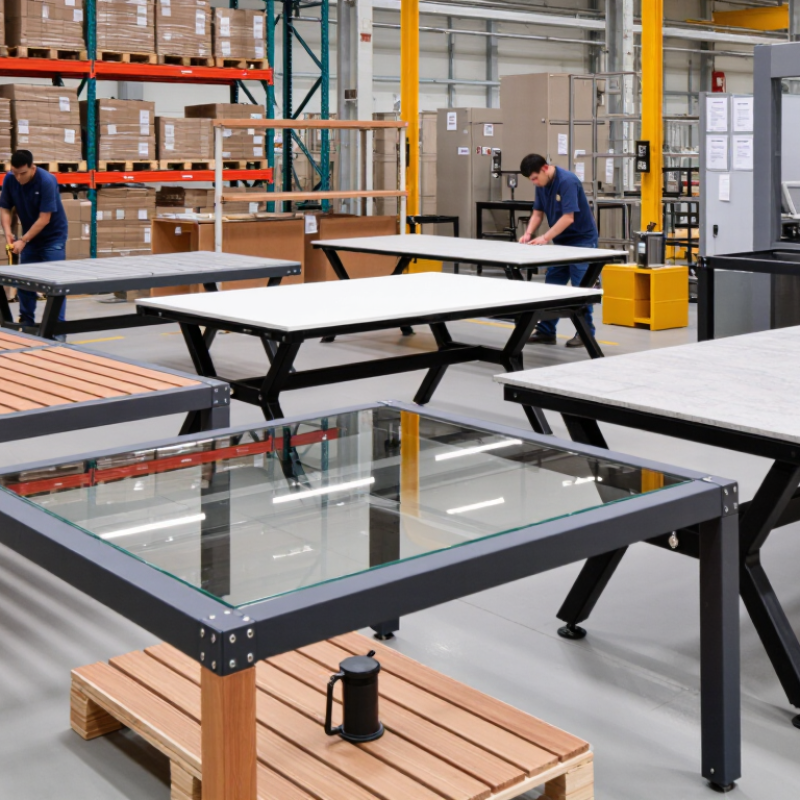
For buyers, production structure affects what can be checked. A factory may weld frames in-house but outsource powder coating, tabletop glass, or packaging. Ask for the production steps, material specifications, and inspection records—not just a showroom sample. A smooth sample can hide uneven welds or weak drainage details. Still, supplier descriptions are not always easy to verify. Factory visits and third-party inspections can help, but add time and cost.

What Defines a Leading Chinese Patio Table Manufacturer

A leading Chinese patio table manufacturer is defined less by a polished catalogue than by consistent production control. Ask how the factory checks frame dimensions, weld quality, and tabletop flatness. Small details matter. On a sample, inspect the underside, corner joints, and adjustable feet, not just the visible surface. Request measurement records and photos from actual production batches. A confident supplier should explain what happens when a component falls outside tolerance.

Material choices should suit the table’s intended setting. Aluminum can be light and practical, while steel often needs careful corrosion protection. For outdoor use, ask what coating process is applied and how its thickness is checked. Finish claims need evidence. Review sample panels, inspect edges, and ask how the surface performs after exposure to moisture and sunlight. A specification sheet is useful, but it cannot replace a physical sample.

Production reliability also depends on communication and packing. Ask for a realistic lead time, a clear inspection process, and updates before shipment. Check whether cartons protect table corners and separate metal parts from scratch-prone surfaces. A scratched corner can spoil an otherwise sound order. Still, no checklist guarantees a perfect partnership; response quality during sampling may differ from communication under a tight schedule. Verify details in writing, then compare the delivered product with the approved sample.

Notable Patio Table Manufacturers and Their Product Specialties

China’s patio-table manufacturers often specialize by material and production method. Some focus on aluminum frames, pairing lightweight legs with powder-coated finishes for easier outdoor maintenance. Others work mainly with teak or acacia, where tight joints, smooth sanding, and consistent moisture control matter. Their tables suit buyers who value natural grain, though wood needs regular care and can vary in color.

A separate group produces ceramic- or stone-top tables, often combining heavy surfaces with steel or aluminum bases. These designs offer a solid feel, but buyers should check edge finishing, table weight, and packaging protection. Manufacturers with mixed-material capabilities may combine woven details, glass, and metal for coordinated patio sets. Ask for close-up samples and clear specifications, not just polished catalog images. Small details matter. I would avoid ranking suppliers by specialty alone: production quality can differ between batches, and advertised capacity does not prove careful finishing. The categories overlap, which makes comparisons less tidy than they first appear.

How Manufacturers Differ in Materials, Design, and Production Capacity

Patio table manufacturers differ most clearly in material choices. Powder-coated aluminum is light and resists rust, but thin tubing may flex under pressure. Steel can feel sturdier, though its coating and welded joints need close inspection. Teak and other outdoor woods bring visible grain; they also need care as weather changes. High-density polyethylene is easy to clean, but surface texture and color consistency vary. Details matter. Check drainage holes, edge finishing, and how the tabletop meets the frame.

Design is more than appearance. A broad table may suit family meals, while a compact folding model helps on a small balcony. Look at leg clearance, umbrella openings, and whether the feet sit evenly on paving. Ask how finishes perform in strong sunlight and humid conditions. A polished sample can still hide weak joinery. I would not treat one attractive display piece as proof of consistent quality.

Production capacity also separates suppliers. Some can handle large repeat orders; others focus on smaller runs with more customization. Ask for a sample from the intended production process, not only a hand-finished prototype. Confirm inspection steps, packaging protection, and realistic lead times. Monthly output figures need context: available machinery, staffing, and current workload all affect delivery. Capacity varies. A clear answer matters more than a big number.

Who Are the Best Patio Table Manufacturers in China? — How Manufacturers Differ in Materials, Design, and Production Capacity

Manufacturer specialization Common materials and construction Typical design strengths Production considerations Often a good fit for
Aluminum-frame specialists Aluminum tube, cast or extruded components, with glass, ceramic, compact laminate, or metal tops. Aluminum does not rust like ordinary carbon steel, though finishes and other components still need suitable outdoor protection. Lightweight designs, clean lines, powder-coated finishes, and tables that can be paired with coordinated outdoor seating. Suitable for repeatable welded-frame production. Capacity depends on fabrication equipment, finishing lines, tabletop sourcing, and order complexity. Buyers seeking relatively lightweight furniture, multiple color options, or coordinated patio sets.
Steel-frame specialists Welded steel tube or sheet metal, commonly protected with a coating such as outdoor-grade powder coating; tops may be steel, glass, or other materials. Strong, visually substantial frames and a broad range of geometric, traditional, or perforated-metal designs. Cutting, welding, surface preparation, and coating quality are important. Coating damage can expose steel to corrosion, so packaging and finish inspection matter. Projects prioritizing sturdy construction, metal detailing, or price-conscious designs, with suitable corrosion protection specified.
Natural-wood furniture specialists Outdoor-suitable hardwoods or other specified timber, with construction and finishing requirements determined by the wood species and intended exposure. Warm appearance, visible grain, and options such as slatted tops, folding tables, or traditional forms. Timber selection, moisture control, joinery, and finishing affect consistency. Wood can weather and may require care; requirements vary by species and climate. Buyers who value a natural look and can specify the wood species, finish, and maintenance expectations.
Woven outdoor-furniture specialists A metal frame with woven synthetic resin wicker or similar outdoor-rated strands; table surfaces commonly use glass or another compatible top. Textured, relaxed styling and coordinated collections that match woven chairs or loungers. Consistency depends on frame accuracy, weave tension, strand quality, and the fit of the tabletop. Hand-finishing can affect labor time and output. Hospitality or residential projects looking for a woven appearance across a matching outdoor set.
Mixed-material and project-oriented manufacturers Combinations such as metal frames with ceramic, glass, compact laminate, or wood tops. Available options depend on the supplier network and in-house processes. More flexibility in finishes, shapes, table sizes, and material combinations; may support coordinated product ranges. More components and suppliers can increase coordination needs. Confirm samples, tolerances, packaging, and production schedules for the complete assembly. Buyers needing custom specifications, several table formats, or a unified look across a larger project.

Note: These are manufacturing specializations, not a ranking of individual factories. Actual production capacity, minimum order quantities, lead times, certifications, and customization options vary by supplier and should be confirmed directly for the specific product and order.

How to Evaluate a Patio Table Manufacturer for Your Needs

Choosing a patio table manufacturer starts with the conditions your tables must survive. Allied Market Research estimated the global outdoor furniture market at $50.4 billion in 2021, with a projected value of $80.6 billion by 2031. Growing demand makes supplier comparisons useful, but market growth alone says little about one factory’s quality.

Ask for material specifications, production photos, and recent test records. Check frame joints, weld finish, table stability, and how surfaces handle UV exposure, moisture, and temperature changes. For coastal projects, ask how metal finishes are tested for corrosion; for heavy-use venues, request load-test details. Confirm minimum order quantities, sample lead times, packaging, and how defects are handled. A polished sample can hide inconsistent production. I would still leave room for a small pilot order; paperwork cannot reveal every fit issue.

Tips: Send the same written specification to each candidate, including dimensions, material grades, finish, and expected use. Compare the answers, not just the quoted price. Ask who inspects products before packing and whether inspection records can be shared. A clear reply is useful, though it is not proof by itself.