Skip to content

What Are the Top 10 Antique Dressing Tables for Buyers?

An antique dressing table can change the feel of a bedroom, but its appeal should not rest on appearance alone. Check the joints, drawers, mirror fittings, and underside for clues about age and condition. Run a hand along the edge. Look for veneer lifting near the corners, replaced handles, and dark marks around old hardware. These small details matter. A polished surface can hide repairs, while honest wear may tell a more useful story.

Designer William Morris offered a fitting principle: “Have nothing in your houses that you do not know to be useful, or believe to be beautiful.” His words are not specific to dressing tables, yet they capture the balance buyers often seek: practical storage, pleasing form, and lasting character. This guide explores ten styles and examples worth considering, from graceful Victorian tables with oval mirrors to compact Edwardian pieces suited to smaller rooms. It also considers what photographs rarely reveal, including wobbling legs, stiff drawers, and mirror silvering that has begun to cloud. A little wear is normal. Not every imperfection is charm, though, and buyers should pause when a restoration looks too fresh or details seem inconsistent. Prices and condition vary widely, so compare carefully and ask sellers clear questions. The right Antique Dressing Table is not always the rarest or most elaborate; it is the one whose craftsmanship, proportions, and condition make sense for your home.

What Are the Top 10 Antique Dressing Tables for Buyers?

How Antique Dressing Tables Are Classified by Period and Design

Antique dressing tables are easier to compare when period and design are considered together. Georgian examples, broadly dating from 1714 to 1830 in Britain, often feature walnut or mahogany, restrained curves, and small brass handles. A cabriole leg or hand-cut dovetail can offer clues, but repairs may blur the evidence. Look underneath, too.

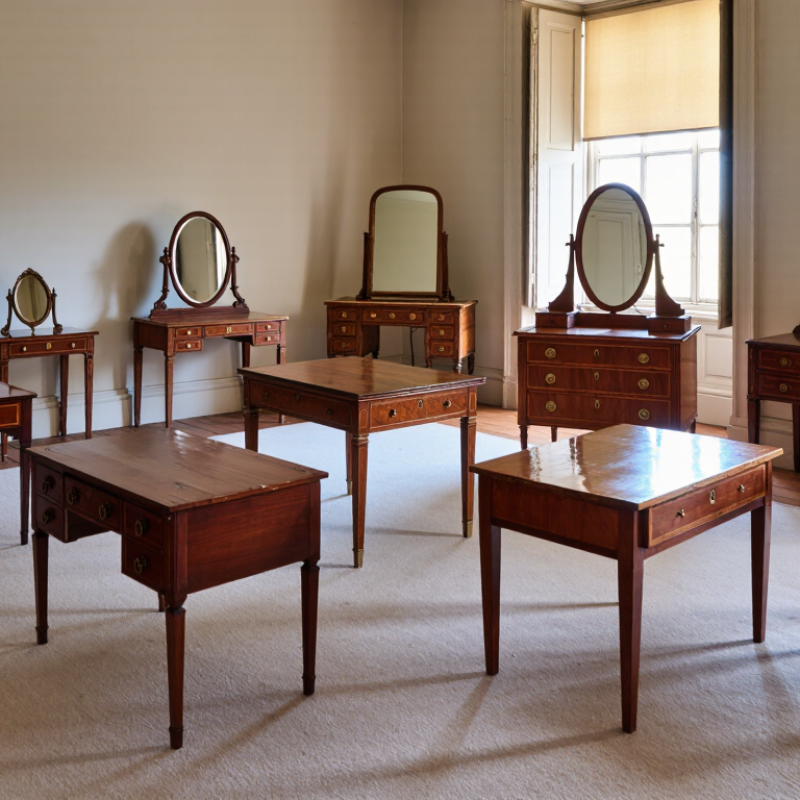
Victorian tables, from 1837 to 1901, commonly have heavier silhouettes, darker finishes, and elaborate mirrors. Edwardian designs tend to feel lighter, with slimmer legs and delicate inlays. Art Deco pieces, usually from the 1920s and 1930s, favor geometric lines, glossy veneers, and stepped forms. These labels are useful, not absolute; regional tastes and later alterations complicate dating.

Market context deserves care. Arts Economics’ 2024 global art-market report estimated worldwide art sales at $65 billion in 2023, down 4% from 2022. That report does not isolate antique dressing tables, so it cannot establish their prices or demand. For a specific piece, compare its construction, veneer condition, mirror glass, and documented history with specialist furniture references. A replaced handle may be minor. A newly applied finish can hide important details.

Ten Antique Dressing Table Styles Buyers Should Know

Antique dressing tables are easiest to compare by their lines, materials, and storage. Queen Anne examples often have cabriole legs and restrained curves. Chippendale pieces may show carved knees, claw-and-ball feet, and richly framed mirrors. Georgian tables tend to feel balanced and formal. Federal designs look lighter, with tapered legs and delicate inlay. Empire styles favor bold proportions and column-like supports.

Look closely. A mirror’s silvering, drawer joints, and finish can reveal repairs or later alterations.

Victorian tables range from heavily ornamented to softly curved; Eastlake examples use crisp incised decoration. Arts and Crafts styles favor sturdy construction and visible wood grain. French Provincial dressing tables often pair cabriole legs with painted or carved details. Art Nouveau pieces may carry flowing, plant-inspired lines.

Patina matters, but it is not proof of age. Grand View Research valued the global furniture market at $766.2 billion in 2023 and projected 5.9% annual growth from 2024 to 2030. That report covers furniture broadly, not antiques specifically, so buyers should treat it as market context, not evidence of antique demand.

Measure the tabletop, inspect drawer bottoms, and ask for documented provenance when available. A beautiful finish can still hide an awkward repair.

Materials and Craftsmanship That Reveal a Table’s History

An antique dressing table’s materials can reveal when and how it was made, but no single detail proves its age. Walnut, mahogany, oak, and maple each show different grain patterns. Look closely at drawer fronts and edges. A thin veneer may be original, not a flaw; lifting, bubbling, or mismatched patches deserve closer inspection. Small details matter.

Craftsmanship offers useful clues. Hand-cut dovetail joints may vary slightly, while machine-made joints often look more uniform. Check drawer runners, underside surfaces, and the backs of panels, where later repairs are easier to spot. A table should feel stable, and its drawers should move without forcing. Listen for a scrape. It may signal wear, not poor quality.

Look at the mirror, too. Slight foxing or softened reflections can accompany age, but replacement glass is common. Brass handles may have uneven color from years of contact, though artificial aging can imitate this. Ask about restoration and request clear photographs of hidden areas. A polished surface can conceal repairs. I would not reject every replaced fitting; careful repairs can preserve a table’s use, while rushed work may obscure its history. A little uncertainty is normal.

10 Antique Dressing Table Styles: Approximate Periods

Compare the broad historical periods associated with these furniture styles. Dates are approximate and vary by region; style alone cannot confirm a table’s age.

To investigate a table’s history, look beyond its style: wood species, veneer, joinery, tool marks, hardware, and mirror fittings can offer useful clues. Repairs and later alterations may affect what those details reveal.

How to Assess Authenticity, Condition, and Restoration

When judging an antique dressing table, inspect the structure before admiring the veneer. Look beneath the top for newer screws, regular machine-cut joints, or fresh glue around old-looking drawers. Check whether wear appears naturally in handles and edges, rather than being evenly rubbed across the surface. Compare the wood, hardware, and construction across the piece; mismatched details may indicate later repairs, not necessarily deception. Ask for dated photographs, prior receipts, or a written restoration history. No paperwork? Treat the story as unverified, not proven.

Condition affects both use and value. Open every drawer, test the runners gently, and look for a musty smell, active insect holes, lifting veneer, or a mirror with cloudy silvering. A small split can be stable; a loose leg is more serious. The 2024 Art Basel and UBS Global Art Market Report estimated 2023 global art sales at $65 billion, down 4%; public auction sales fell 7% to $25.1 billion. These figures cover the wider art market, not dressing tables, but they caution against assuming every asking price reflects demand. Get a specialist’s written condition report before bidding.

Restoration should preserve evidence, not erase it. Ask what was replaced, whether the finish was stripped, and if repairs can be reversed. Request close-up images of joints and the underside. Fresh polish can look persuasive. It can also hide age. I would not rely on a dealer’s age estimate alone; compare it with independent appraisal and construction details. A slightly uneven drawer may be honest wear, but it still deserves careful inspection.

What Are the Top 10 Antique Dressing Tables for Buyers? — How to Assess Authenticity, Condition, and Restoration

A buyer-oriented selection of notable dressing-table styles. Dates are approximate style periods, and a style label alone does not prove that a piece was made during that period. Assess construction, materials, condition, and documentation together.

No. Style and typical period Recognizable features Authenticity checks Condition and restoration points Buyer’s assessment
1 Queen Anne styleEarly 18th century; the style continued beyond Queen Anne’s reign (1702–1714) Often has a restrained silhouette, cabriole legs, shaped aprons, and a small number of drawers. Walnut was commonly used in English examples. Look for construction consistent across the whole piece, including drawer backs, undersides, and secondary wood. Cabriole legs or a particular timber alone cannot establish age. Check for repaired or replaced feet, loose leg joints, drawer runners, and later hardware. Veneer losses and old repairs are common; assess their extent and stability. Good for buyers seeking an early, relatively compact form. Ask whether major components, such as the top, legs, or drawer fronts, have been replaced.
2 Georgian dressing tableApproximately 1714–1830 A broad category that includes several changing designs, from formal, symmetrical case furniture to more refined pieces with shaped fronts and decorative veneers. Compare the design, joinery, timber, and hardware with the claimed date. Hand-cut dovetails can be a useful clue, but dovetail shape varies and is not proof of age by itself. Inspect the top for splits, stains, and veneer lifting. Check drawer bottoms and runners for later replacements, and note whether the finish has been heavily stripped or renewed. Because the period covers more than a century, request a more specific date and explanation of the attribution rather than accepting “Georgian” as a precise date.
3 Chippendale-style dressing tableMid- to late 18th century; the style also inspired later reproductions May feature carved knees, claw-and-ball or other decorative feet, pierced galleries, or elaborate fretwork. Features vary by region and design. Examine carving for consistent toolwork and natural wear in protected areas. Check whether the design and construction agree; ornate carving alone does not make a piece period-made. Look closely for re-cut carving, added decorative elements, repaired ankles, and replaced feet. Repairs to carved areas can be difficult to see under dark finishes. Especially important to have a specialist assess a high-value attribution. Ask for clear photographs of the underside, joints, back, and any carved details.
4 Federal or Neoclassical dressing tableLate 18th to early 19th century, especially in the United States Typically emphasizes symmetry and classical motifs; examples may have tapered legs, delicate inlay, and lighter visual proportions. Check that inlay, veneer, and secondary woods appear compatible with the claimed period. Look for consistent aging and construction rather than relying on a single decorative motif. Fine veneer and inlay can be vulnerable to lifting, losses, and old patch repairs. Inspect tapered legs for splits, shortening, and later blocking or reinforcement. A strong option for buyers who value balanced proportions and fine surface detail. Confirm whether the inlay and finish are original, repaired, or renewed.
5 Regency dressing tableApproximately 1811–1830 in Britain; the wider Regency style spans a broader period May combine classical forms with dramatic veneers, brass mounts, reeded details, or a raised mirror arrangement, depending on the design. Assess mounts, mirror supports, and case construction as a whole. Newer screws or hardware may indicate repairs or later alterations, but are not conclusive without other evidence. Check mirror pivots and supports for wobble, and inspect brass mounts for missing pieces or replacements. Veneer cracks, loose mounts, and unstable feet need careful evaluation. Verify that the mirror, supports, and base belong together. A dressing table assembled from components of different dates should be described as such.
6 Victorian dressing table or washstand1837–1901 Often larger and more decorative than earlier examples. Some dressing tables include a mirror; related washstands may have a stone top and a splashback. Look for construction and materials consistent with the specific design and date. Distinguish a dressing table from a washstand, and check whether a mirror or stone top is original to the piece. Inspect marble or other stone for cracks, stains, and replaced sections. Check mirror silvering, drawer operation, veneer, and any water damage around the top. Often offers a substantial presence and practical storage. Include the cost of safe handling and repair when assessing heavy stone tops or large mirrors.
7 Eastlake and Aesthetic Movement stylesMainly 1870s–1890s Eastlake-influenced examples may use geometric carving and relatively rectilinear forms; Aesthetic Movement designs can feature stylized natural or decorative motifs. Compare ornament, proportions, and construction with the claimed style. Similar-looking later furniture exists, so inspect the back, underside, drawer construction, and hardware for consistency. Check carved details for damage or excessive refinishing, and inspect veneer edges, drawer stops, and mirror frames. Replaced mirrors and hardware should be noted. Useful for buyers interested in late 19th-century design. Ask whether decorative parts are original and whether any surface has been stripped or refinished.
8 Arts and Crafts dressing tableLate 19th to early 20th century, with regional variation Often favors visible wood grain, straightforward forms, and restrained decoration. Oak is common in many examples, but materials and details vary. Assess workmanship and materials rather than assuming that a simple design is period-made. Look for coherent joinery and a consistent finish across visible and concealed areas. Check joints for movement, tops for water marks, and the finish for heavy sanding or modern coatings. Examine any mirror frame and fittings for later replacement. A good choice for buyers who prefer practical, understated furniture. Confirm that repairs have not weakened the joints or substantially changed the original surfaces.
9 Art Nouveau dressing tableApproximately 1890–1910 May have flowing lines, asymmetrical forms, and stylized plant-inspired carving or inlay. The degree of ornament varies widely. Look for design and construction that work together; organic ornament can also appear on later pieces. Check the mirror, frame, and case for compatible materials and evidence of alteration. Inspect curved or carved components for cracks, repairs, and losses. Check mirror mounts and joints carefully, as unusual shapes may make replacement parts harder to source. Best assessed in person where possible. Photograph details and ask a qualified restorer about the feasibility of repairs before buying a damaged example.
10 Art Deco dressing tablePrimarily 1920s–1930s; whether it qualifies as an antique depends on the applicable definition May feature geometric forms, stepped profiles, contrasting veneers, and large mirrors. Materials range from solid timber to veneered and mixed-material construction. Check the veneer pattern, case construction, mirror fittings, and finish together. Later reproductions and restorations exist; a geometric design alone does not establish a period date. Look for lifting veneer, chips on corners, mirror-edge deterioration, and damage to lacquer or other finishes. Confirm whether missing fittings or panels can be matched. Confirm the date and local definition of “antique” if age classification matters to the purchase. Review restoration costs, especially for damaged veneer and large mirrors.

Factors to Consider When Buying an Antique Dressing Table

When buying an antique dressing table, start with its size and structure, not its patina. Measure the room, doorway, and stairwell; a graceful piece can be awkwardly large in practice. Check whether the legs sit evenly and whether the top wobbles under gentle pressure. Open every drawer. Smooth movement is reassuring, but slight sticking may reflect age rather than serious damage.

Look closely at joints, veneer, and the mirror. Original hand-cut joints and small wear marks can support an older construction, though no single detail proves age. Use a flashlight to inspect veneer edges for lifting or fresh repairs. Check the mirror for silvering loss, cracks, and secure brackets. A cloudy reflection may be charming, but replacement glass can change the table’s character. Look closely.

Ask the seller what is known about the table’s history and repairs. Written records, old receipts, or clear photographs can help, but gaps in provenance are common. Compare the asking price with similar pieces in similar condition, and include delivery or conservation costs. Smell the drawers for persistent dampness or strong chemical odors. I would not assume every uneven finish is original; sometimes age and later neglect look surprisingly similar. If possible, have a reputable furniture conservator inspect costly repairs before you commit.